
Agents Will Be the Translation Layer of Corporate Accounting
Published on TenKey.ai on March 22, 2026

As any seasoned accountant knows, the majority of effort for corporate accounting teams is not spent on producing clean financial records. It is spent making the underlying information usable in the first place.
This is a translation problem.
Every accounting system is built to operate on structured, standardized inputs. Fields must be filled. Categories must be selected. Dates, amounts, and counterparties must be clear and consistent. Even where GAAP requirements apply, the accountant is primarily cleansing the data monthly for real time management reporting. Communication happens in natural language, meaning essential information is implied rather than stated, and not in the rigid schema that existing systems require.
Bridging this gap has always been the job.
An accountant reads an input (email, bank transaction, internal ledger, etc), interprets its meaning, determines whether it represents a valid obligation/right, identifies what information is missing, and decides how it should be recorded. What appears in the system as an objective fact is the result of a series of judgments that took place outside of it. The system does not perform this work. It merely reflects its outcome.
This is most visible in accounts payable, where the distance between incoming information and system-ready data is particularly wide. The shared inbox, rather than any other system in the process, is the operational center of gravity. It is where invoices arrive, where vendors ask questions, where discrepancies surface, and where context is gleaned. It is also where the limits of existing systems are most apparent.
The AP inbox is unstructured, continuous, and conversational; the ERP is none of those things.
For decades, software has been able to store and process financial data with increasing efficiency, but it has not been able to meaningfully participate in this intermediate layer. It could not interpret ambiguity, resolve incomplete information, or engage in the back-and-forth required to clarify it. Every time the software lacked required context (which is often), the automation broke and the accountant had to step in and do it by hand.
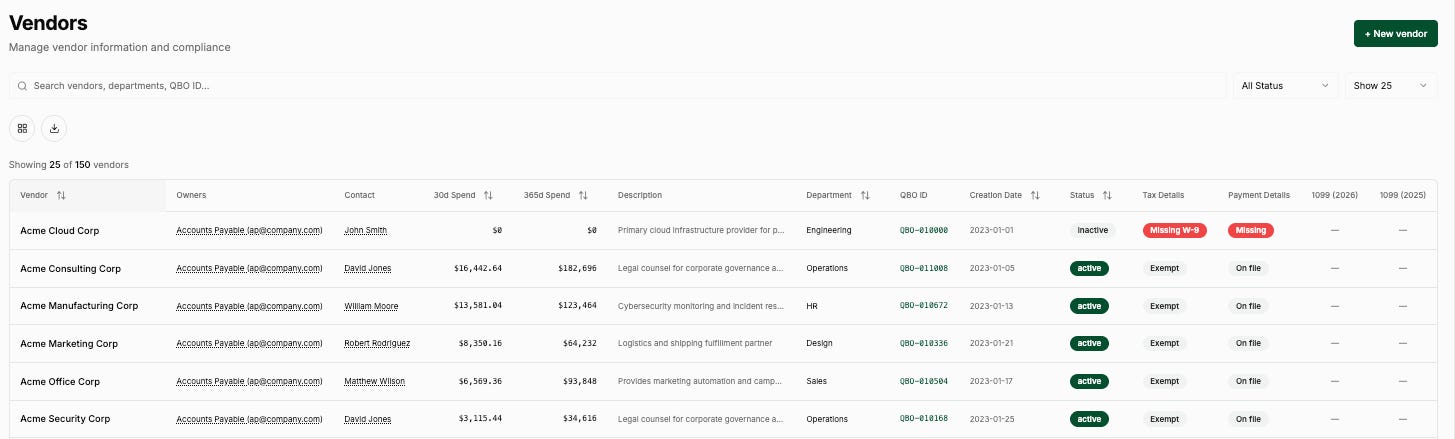
TenKey translating unstructured AP inputs into structured, system-ready data
What is changing now is that software can operate within the space that was previously reserved for human judgement. Agent harnesses now (within 2026!), are making it possible for systems to read unstructured inputs, infer intent, identify gaps, and take action to resolve them. A system can now recognize that an email contains an invoice, determine whether key information is present, check it against existing records, and, when necessary, follow up to request what is missing.
This is a fundamentally different capability. It is not the automation of a predefined sequence of steps. It is the ability to translate.
Once that layer is addressed, the rest of the system begins to function as intended. Downstream processes become more reliable because they are no longer compensating for incomplete or inconsistent inputs. Errors decrease not because controls have tightened, but because ambiguity has been resolved earlier in the process. The role of the accountant shifts accordingly. Accountants spend less time interpreting raw inputs and more time reviewing outcomes and applying judgment where it is truly needed.
We started TenKey to turn systems of record into systems of doing.
We started TenKey to build the translation layer for accounting teams. What has emerged over the past few months (OpenClaw and Cowork) has only reinforced how inevitable this shift is. AI is moving from something that assists work to something that actually does it, operating across systems with context, memory, and agency.
While OpenAI and Anthropic are building the underlying primitives for this future, the real opportunity now is to apply that capability to the parts of the economy that have never had it. We believe accounting is one of them, and that the agentic translation layer it has long relied on, burning the midnight oil, will finally be built into the system itself.